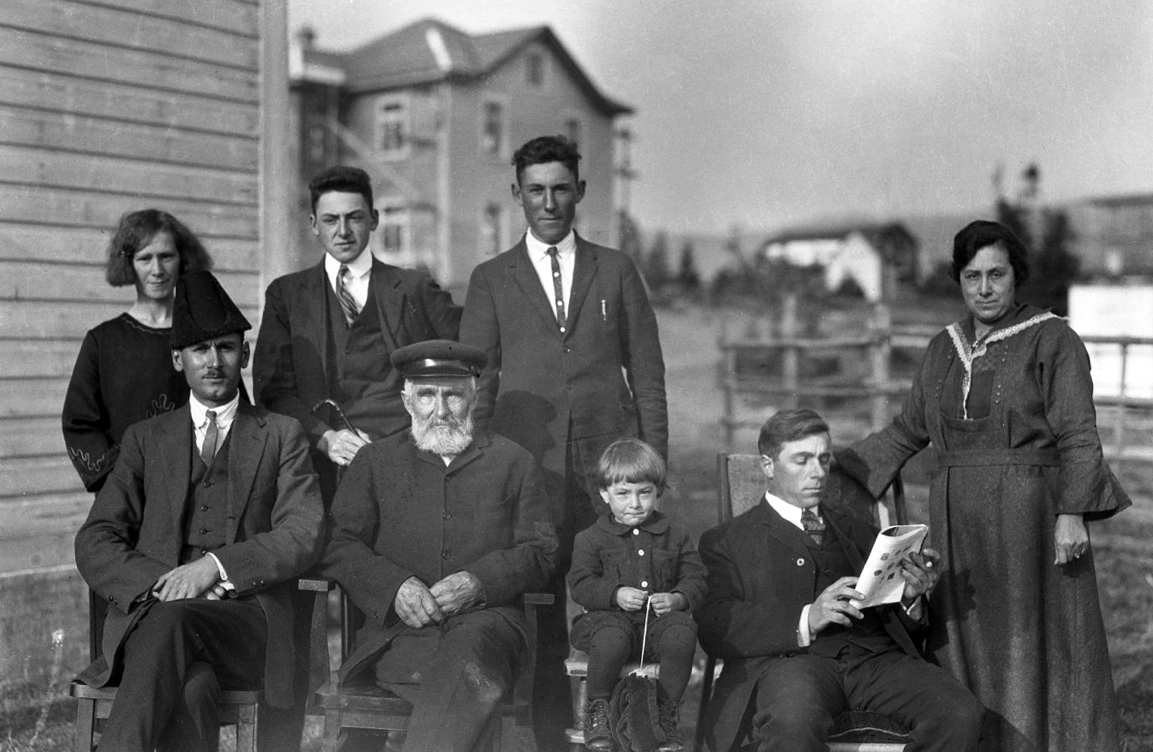
- Québec parish registers date back to 1621 and often name parents, spouses and places of origin.
- Women are generally recorded under their birth name, which makes them easier to trace across generations.
- Search every name under all its variants, including dit names and anglicized forms.
- A marriage record is often the key to identifying a person’s parents and moving back a generation.
- Verify every link against the original record and always keep track of your sources.
Why Search for Your Québec Ancestors?
There are many reasons to research one’s family history, or genealogy. The motivations are personal to everyone who undertakes this journey.
- Where does my family come from? For some, this can mean finding the house where grand-papa was born. For others, it can mean locating the exact place in France where their first patronymic ancestor—the ancestor who carried their surname—was born a dozen generations ago. For adoptees, this can represent an even larger question of identity.
- Were any of my ancestors involved in historic events? Some might want to know whether anyone in their family served in the military. Others may want to understand what life was like for their ancestors during a significant event, such as the Siege of Québec.
- Is that family story true? Most families have stories and traditions that have been passed down from generation to generation. Genealogical research can sometimes separate fact from fiction.
- Why did my family leave Québec? Many descendants of Québec families live elsewhere in Canada or the United States today. Genealogy can help trace those migrations and uncover when, where and sometimes why a family moved.
- What were my ancestors’ lives actually like? Genealogy can reveal much more than names and dates. Records can tell us about an ancestor’s occupation, community, property, family relationships and other details that help us understand how they lived.
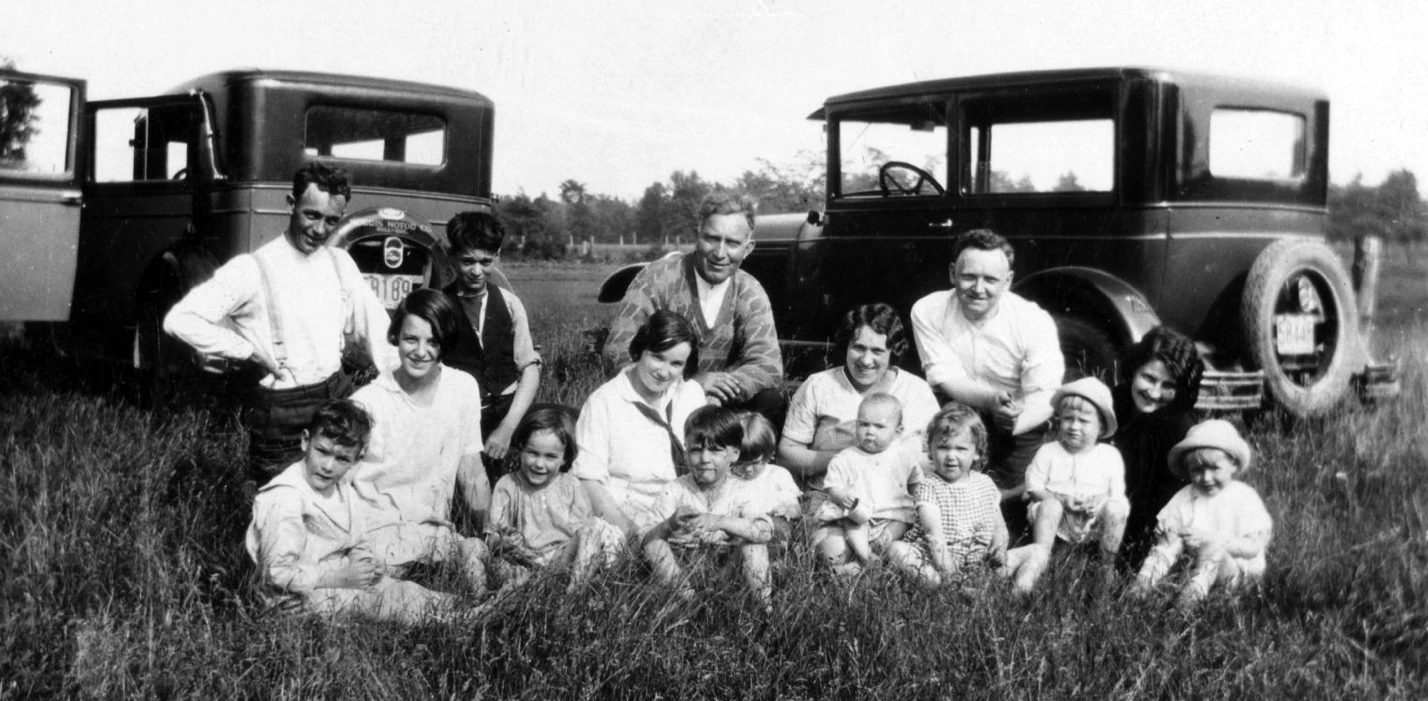
What Makes Québec Genealogy Unique?
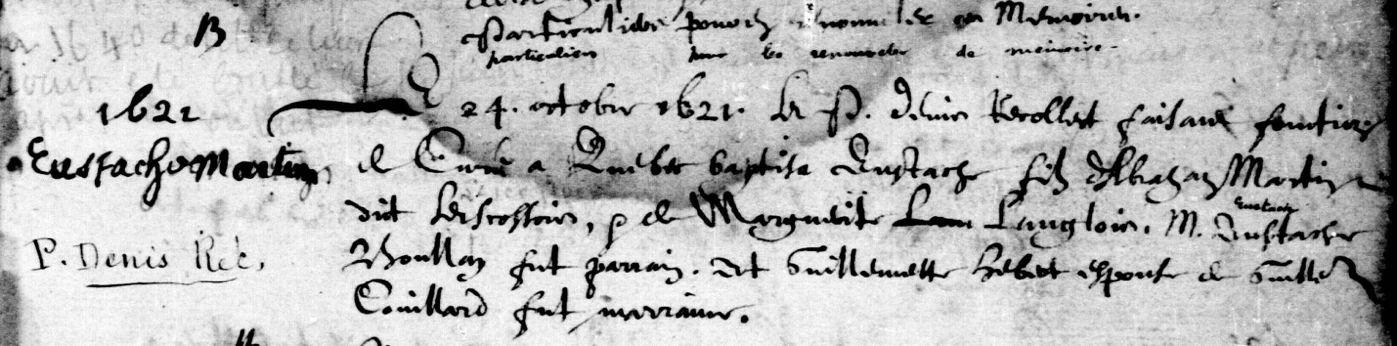
Those researching their roots in Québec will soon discover the extraordinary richness of the genealogical records available. Catholic parish registers recording baptisms, marriages and burials survive from as early as 1621. These records are often remarkably detailed and consistent, identifying not only individuals but also parents, spouses, maiden names, places of origin and family relationships. Together, they create an unusually rich documentary trail through generations of Québec families.
Researchers new to Québec genealogy may notice that historical records are usually described as baptisms, marriages and burials, rather than the more familiar births, marriages and deaths. For most of Québec’s history, civil status was recorded through religious registers, maintained largely by priests and other ministers of religion. As a result, the records were framed around religious events. A baptismal act usually gives both the child’s date of birth and date of baptism, while a burial act often records the date of death as well as the date of burial. Births and deaths are therefore not missing from the historical record; they are generally documented within baptism and burial entries. This system remained closely tied to religious registers until 1994, when Québec established a single centralized civil status register.
Another reason Québec’s parish records have survived so well is that, beginning in the 17th century, registers were generally kept in duplicate. One copy remained with the parish while another was deposited with the civil authorities. If one register was lost or damaged, a second copy could therefore sometimes preserve the record.
Beyond parish registers, Québec researchers can draw on an impressive range of other historical records. The first colony-wide census dates to 1666, during the time of New France, while an enormous collection of legal and notarial records, dating back to 1626, documents our ancestors’ lives in fascinating detail. These records capture everything from marriage contracts and voyageur engagements to testaments and neighbourly disputes over a fence.
Better yet, many of the records most useful to genealogists have been digitized and indexed, allowing researchers to explore centuries of Québec family history from the comfort of home in a way that would have been unimaginable only a few decades ago. Large databases have transformed this research even further. Genealogy Québec, maintained by the Drouin Institute, provides access to millions of indexed records and digitized images, while the PRDH-IGD has reconstructed generations of Québec families by linking individuals, couples and their children across historical records. Together, resources such as these make it possible to trace many Québec families across multiple generations with remarkable continuity.
If you do not speak French, don’t be discouraged. Parish registers tend to follow recurring formulas, and you do not need to be fluent in French to begin working with them. We’ll explore how to read these records, including common terms and vocabulary, in a later lesson.
Taken together, these records and resources place Québec researchers in a unique and enviable position. Centuries of family history are preserved in an extraordinary range of sources, many of them readily accessible today. A vast documentary universe is waiting to be explored.
Understanding Names in Québec
Names in Québec can present researchers with both significant advantages and challenges.
Women in Québec are generally identified by their birth or maiden names in Catholic parish records, following French custom. Marriage did not automatically change a woman’s surname, making it considerably easier to follow women from one generation to the next than in places where married women were routinely recorded under their husbands’ surnames. There are exceptions, however. Protestant registers and historical census records may identify a married woman under her husband’s surname.
This tradition continues in modern Québec. Since 1981, both spouses retain their birth surnames after marriage and use those names to exercise their civil rights. A person may use a spouse’s surname socially, but marriage itself does not result in a legal change of name.
In Québec records from the 17th through the 19th centuries, the spelling of names could vary considerably. A name might be written according to its pronunciation or according to the preference of the priest, notary, clerk or individual recording it. Illiteracy could contribute to this variation, but even educated people sometimes spelled their own surnames differently. In one 1816 marriage record, for example, the Hénault family name is recorded using three different spellings. The family name Boulé can likewise appear as Boullé, Boulay, Boulet or Bouley. Given names could vary as well. The female given name Josèphe could also be written as Josephte or Josette.
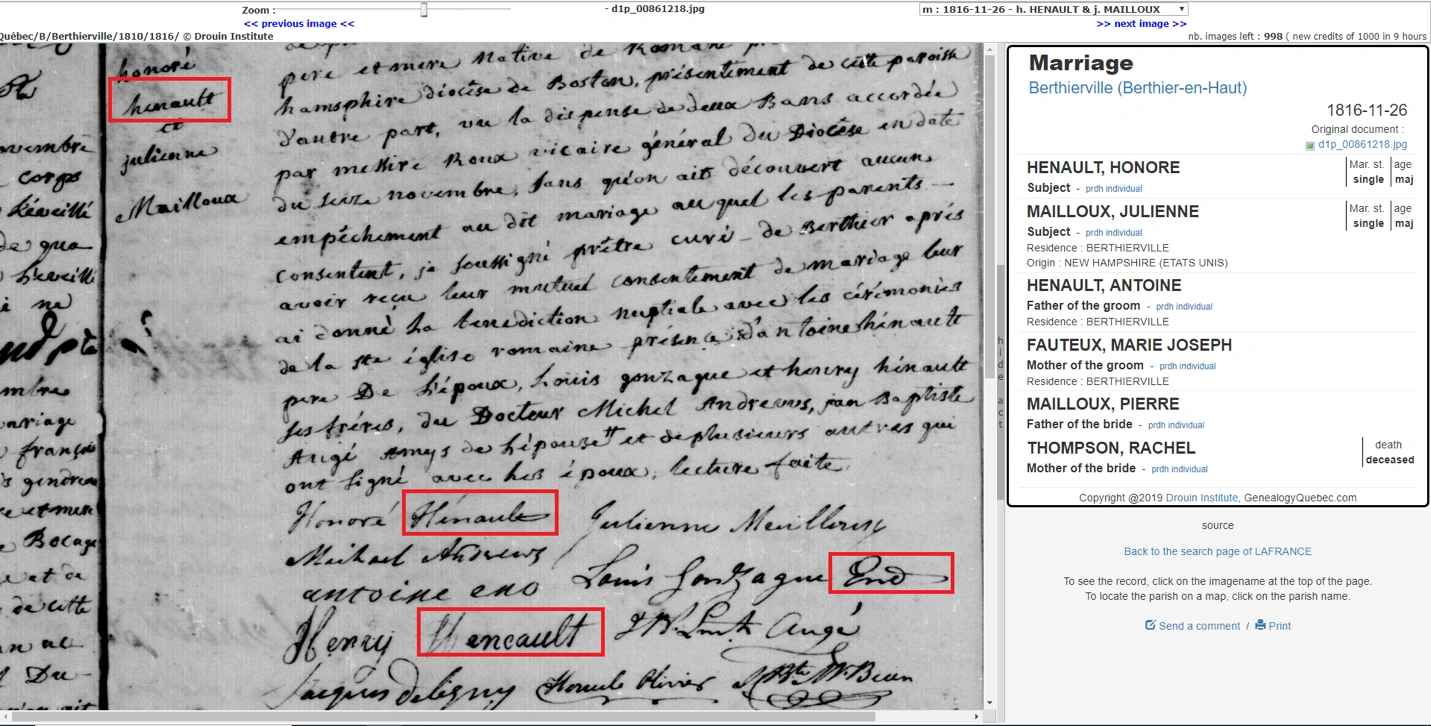
These variations need to be kept in mind when undertaking research. A search for only one exact spelling can easily miss a relevant record.
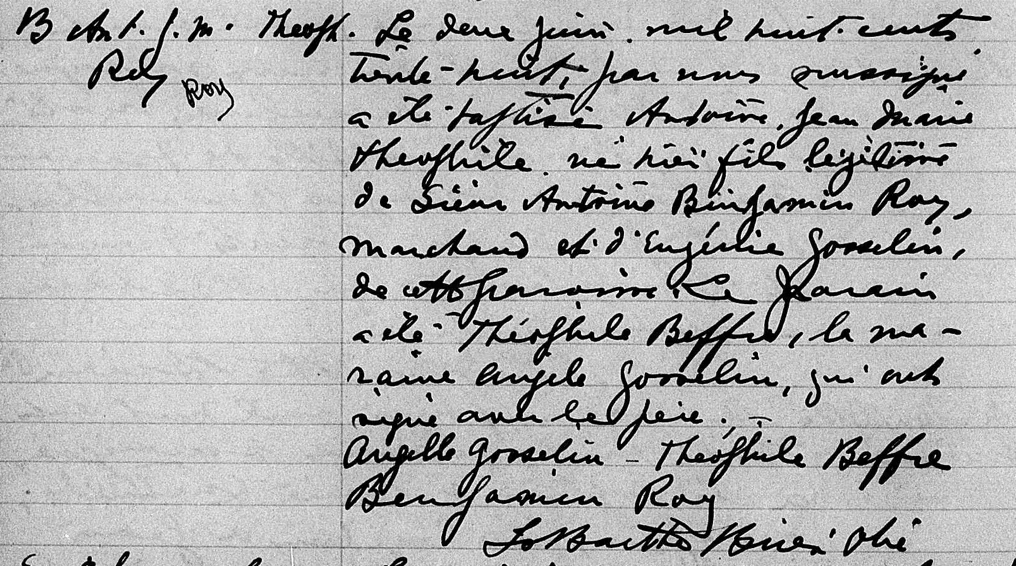
Historically, Catholic children in Québec were often baptized with multiple given names. Religious names such as Joseph and Marie were common, for both boys and girls. Names recorded at baptism were not necessarily the ones a person used in everyday life. Nor did given names always function as a fixed set of identifiers in the way we might expect today. A person might appear under one given name in one record and another elsewhere, or alternate between names over the course of a lifetime. Antoine Jean Marie Théophile Roy, for example, was baptized with four given names in 1838. He would not necessarily have used all four in daily life.
If an ancestor left Québec, they may have altered or anglicized their surname in English-speaking Canada or the United States. Sometimes the change is easy to recognize, such as Delorme becoming Delarm or Côté becoming Coty. Others require considerably more imagination, like Langevin to Langway, Lefebvre to Bean, Bellefeuille to Leaf, or even Massicot to Mexico.
Perhaps the most challenging aspect of Québec genealogy is the concept of “dit” names. A dit name is a secondary surname that could be added to a family name and, in some cases, eventually replace it. The French word dit literally means “said,” but in this context is better understood as “called” or “also known as.” The feminine form, dite, may appear with a woman’s name.
Military noms de guerre were one important source of dit names. French soldiers were often given or used secondary names during their military service, and some soldiers who settled in New France continued to use them. But dit names had many other origins. They could refer to a person’s place of origin, a physical characteristic, a fief or property, a mother’s surname, an occupation or another characteristic used to distinguish one person or family from another.
Some dit names were used by only one individual or one branch of a family, while others were passed down through several generations. Over time, descendants might use the original surname, the dit name, or both. For example, members of the Roy dit Desjardins family might appear in different records as Roy, Desjardins or Roy dit Desjardins.
The possibility of a dit name should always be kept in mind when searching for an ancestor. If you encounter one, search under both surnames separately as well as together. An ancestor who seems to have disappeared may simply be hiding under the other name.
Québec Genealogy Is Not Exclusively French Catholic Genealogy
Although Catholic parish registers dominate traditional French-Canadian research, Québec has long been home to Protestant, Jewish and other religious communities. Their records also form an important part of Québec genealogy. For much of Québec's history, records kept by authorized religious officials served not only a religious purpose but also formed part of the civil registration system. As a result, substantial collections of non-Catholic birth or baptism, marriage and burial records survive today.
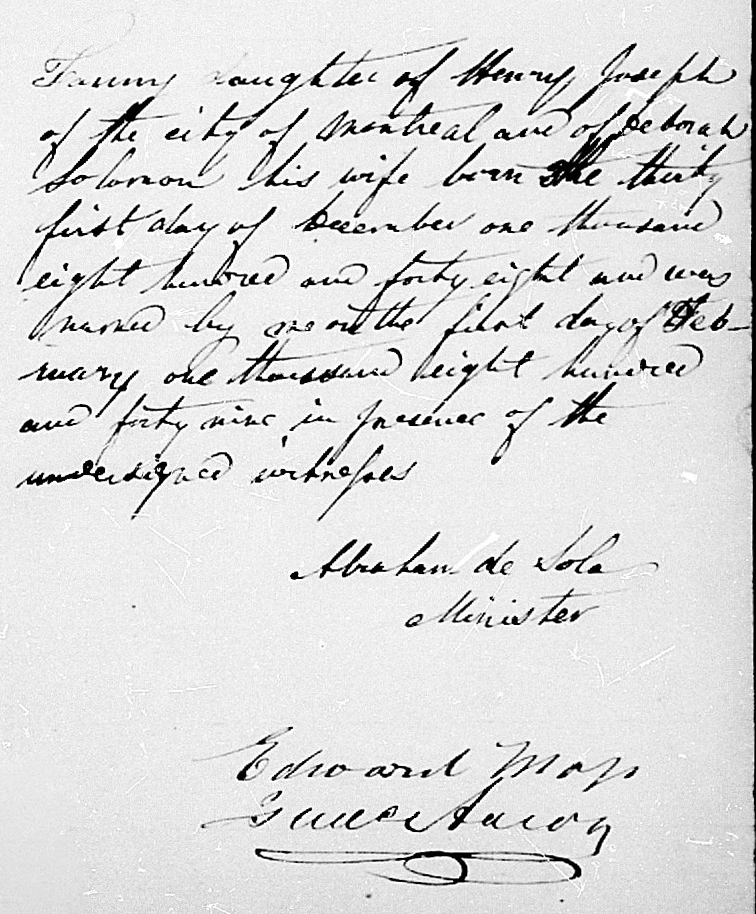
Researching these communities can require a somewhat different approach. Protestant churches, for example, were not always organized into the same territorial parish system used by the Catholic Church. A single minister might serve several scattered communities and record their baptisms, marriages and burials in one register. The amount of information recorded could also vary considerably and was often less detailed than in Catholic registers.
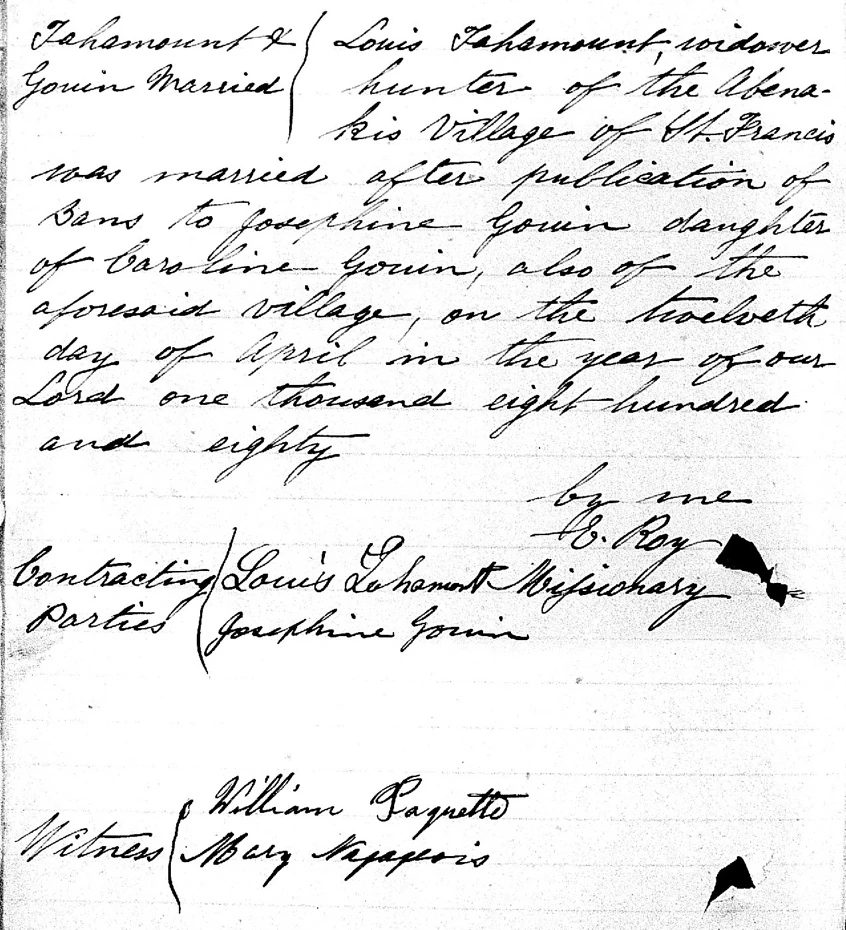
The 1880 Protestant marriage record of Louis Tahamont and Josephine Gouin, for example, provides relatively little identifying information about the couple compared with a typical Catholic marriage record of the period. One particularly valuable clue is the name of Josephine's mother, which helps establish her identity.
Religion should not always be treated as a rigid guide to where a record will be found. Some parts of Québec, including areas of the Eastern Townships, developed substantial Protestant communities before Catholic parishes and resident priests were established nearby. Catholic families might instead be served periodically by travelling missionaries, whose records could be kept with a distant parish or mission. In some circumstances, Catholic couples also married before Protestant ministers when convenient access to a Catholic priest was unavailable.
For that reason, don't assume that a Catholic ancestor will always appear in a Catholic register, or that a French surname necessarily identifies a Catholic family. If a record cannot be found where expected, broaden the search to neighbouring parishes, missions and other religious denominations.
Migration: Your Québec Ancestors May Not Stay in Québec
Québec families did not necessarily remain in Québec. Over the generations, many moved into Ontario, New Brunswick and Western Canada, while enormous numbers crossed the border into the United States. For genealogists, this means that records created outside Québec may be essential to following a family from one generation to the next.
One of the largest population movements occurred between the mid-19th century and the Great Depression. Historians estimate that net emigration from Québec to the United States reached approximately 925,000 people between 1840 and 1930. Many settled in New England, where rapidly growing industrial towns offered employment in textile and other factories. Economic pressures at home, including limited agricultural opportunities in long-settled parts of Québec, combined with the prospect of jobs and higher wages in the United States to encourage migration south.
Migration often followed family and community networks. One person might leave first, followed later by siblings, parents or other relatives. In New England, French Canadians established sizeable communities sometimes known as “Little Canadas,” complete with French-language churches, schools, newspapers and businesses.
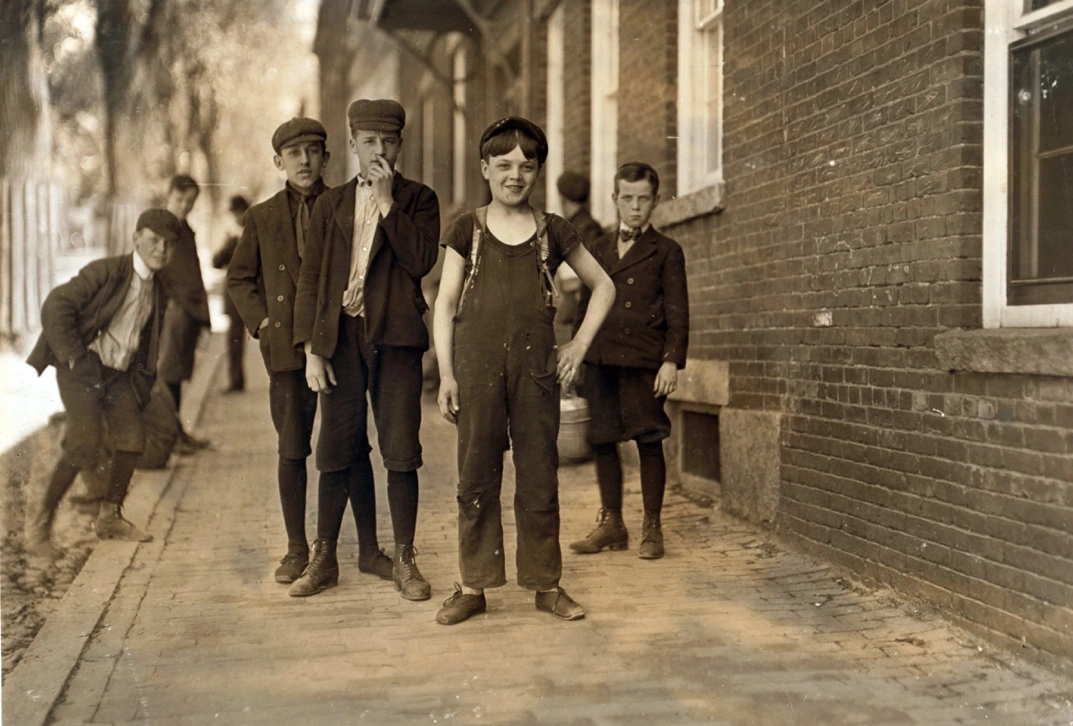
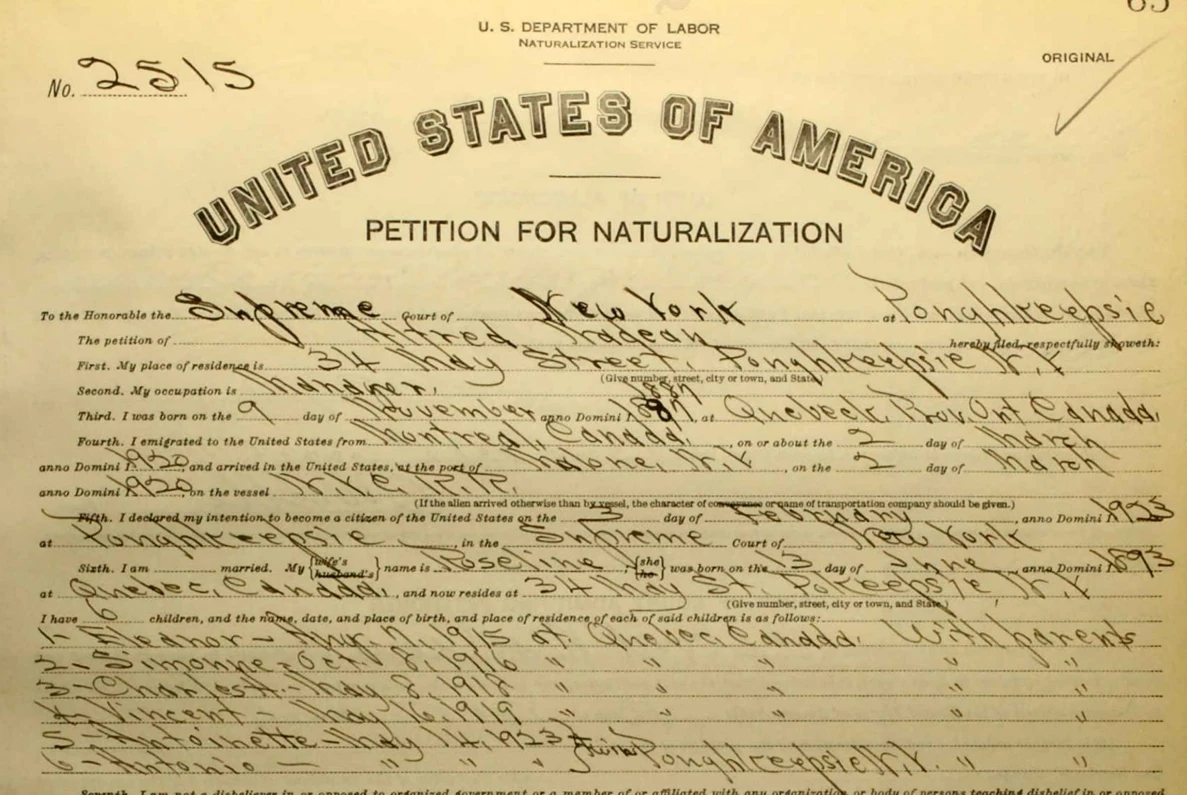
For researchers, crossing the border can complicate the paper trail. Names might be spelled differently or anglicized, and a Québec birthplace might be recorded simply as “Canada” or “Canada French.” U.S. censuses, vital records, Catholic parish registers, border-crossing records and naturalization files can all provide clues that connect an emigrant back to their Québec family.
If an ancestor seems to disappear from Québec records, expand the search geographically. Look for siblings and other relatives as well, since families frequently migrated together or followed one another to the same destination. A record created many years after an ancestor left Québec may contain the birthplace, parents’ names or other detail needed to identify where they came from.
A Few Principles of Good Genealogical Research
1. Start with what you know
Begin with yourself, your parents and your immediate family, then work backward one generation at a time. Record the dates and locations of major life events such as births, marriages and deaths. Gather information that already exists within your family as well. Talk to relatives, particularly older generations, and look for certificates, obituaries, funeral cards, photographs, letters and other family documents that may provide useful clues. In Lesson 2, we'll show you how to get started.
2. Use marriage records to establish parentage
In Québec genealogy, a marriage record is often the key to identifying a person’s parents and moving back another generation.
An example: You know that your great-grandparents were Jean Tremblay and Marie Girard. Based on the date of birth of their son, your grandfather, you may have an approximate timeframe for their marriage (before 1875) and perhaps a geographic area based on where the family lived (Saguenay–Lac-Saint-Jean). Your next step should be to locate Jean and Marie’s marriage record. It will likely identify both sets of parents, helping you establish the previous generation and then locate the correct baptismal records.
Using the general search at Généalogie Québec, a marriage record for Jean Tremblay and Marie Girard was located in 1871 in Laterrière, Saguenay. A later lesson will provide more detailed instructions on how to search the site.
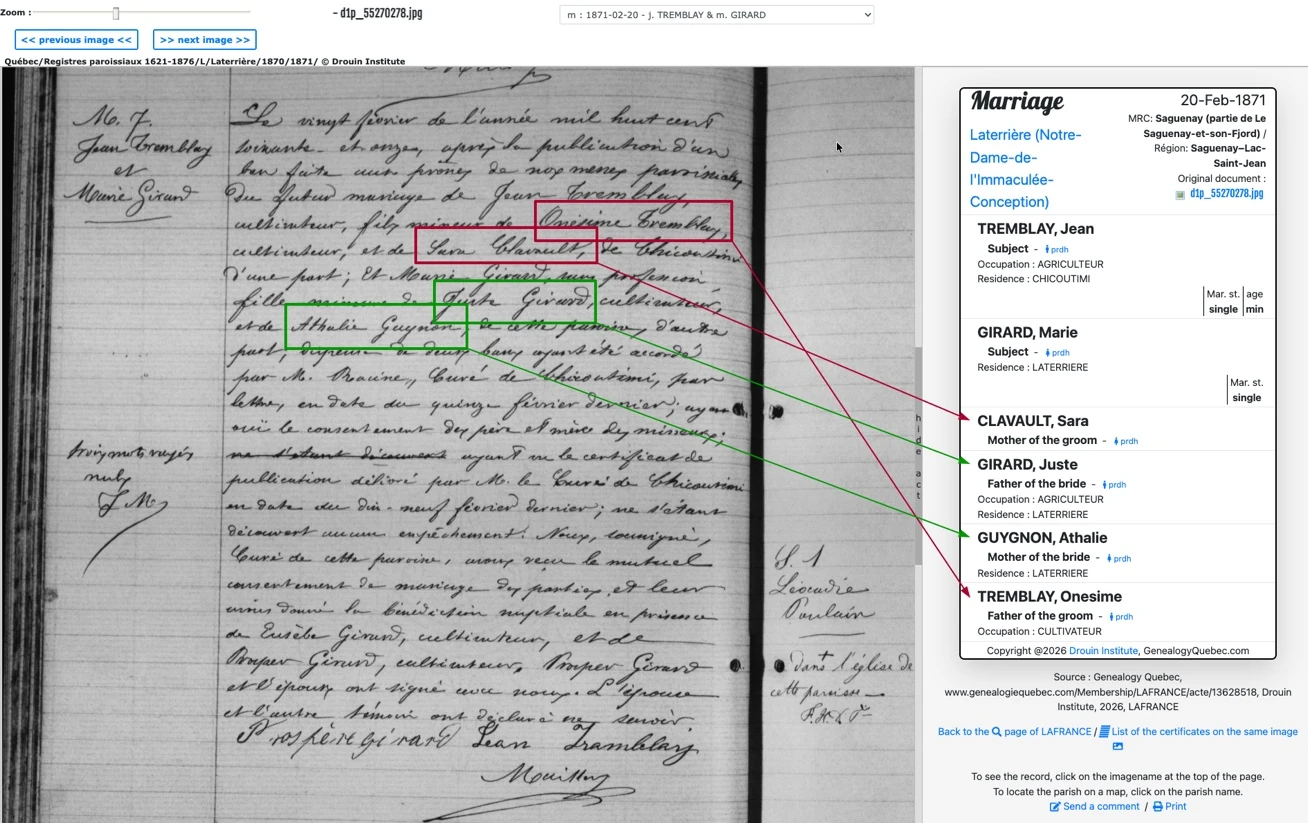
You now know that Jean Tremblay’s parents were Onésime Tremblay and Sara Clavault. You can use those names, along with Jean’s approximate age and place of residence, to search for the correct baptismal record and continue the line backward.
If you began instead by searching for Jean Tremblay’s baptism, you might find numerous boys with that name and have no reliable way to determine which one was your great-grandfather. Establishing parentage before moving backward is especially important when dealing with common names.
3. Work slowly and methodically
When beginning genealogical research, it is understandable to want to go back as far as possible. With so many Québec family trees already available online, it can also be tempting to accept someone else’s research and quickly add generations to your own tree.
Move backward one generation at a time and verify each relationship before continuing. Public family trees can provide useful clues, but they are created by other researchers and may contain errors that have been copied from tree to tree. Nobody wants to discover years later that they have been climbing the wrong branch of the family tree.
4. Consult the original record whenever possible
Indexes, abstracts and database search results are extremely useful for locating records, but they do not always reproduce everything found in the original document. Names may be mistranscribed, details may be omitted, and handwriting can be interpreted incorrectly. Whenever an image of the original record is available, examine it yourself before adding the information to your family tree.
5. Always keep track of your sources
Few things are more frustrating than returning to an ancestor and being unable to determine where a piece of information came from. Where did that date of death come from? Family information? An obituary? A burial record?
Recording your sources allows you to find the information again, evaluate its reliability and help other researchers retrace your work. Depending on the source, record details such as the title of a book and page number, the collection and record image, a microfilm number, or the name and date of a conversation or email from a relative.
6. Expect records to disagree
Genealogical records were created by different people, at different times and for different purposes. An ancestor’s age may vary between censuses, a surname may be spelled differently from one record to another, or a birthplace might be recorded simply as “Canada” in one document and as a specific Québec parish in another. Do not automatically discard a record because one detail differs from what you expected. Compare all of the available evidence, including names, relatives, dates, locations and other identifying details, before reaching a conclusion.
7. Research one question at a time
Decide what you are trying to establish before you begin searching, and keep a simple record of the collections and sources you have already checked, including searches that produced no result. This is especially important when working through a complex research problem where the answer is not immediately apparent. A clear research question and search log can help you avoid repeating the same work and make it easier to evaluate clues as they emerge.
These principles aren't a checklist to complete once and forget. They're habits worth carrying through every stage of your research, from your very first search to your hundredth. Move carefully, verify as you go, and let the records, not assumptions, guide your conclusions. Québec's exceptional documentary record rewards patience far more than speed.
In the next lesson, we'll put these principles into practice and show you how to begin: starting with your own family, gathering what you already have, and building the foundation your research will stand on.
Frequently asked questions
Until 1994, Québec’s civil registration was kept in religious registers. A baptism record usually gives the date of birth, and a burial record the date of death.
A secondary surname added to the original one, which sometimes replaced it over time. Descendants of the Roy dit Desjardins family may appear as Roy, Desjardins or both: search under each form.
In the censuses, vital records, parish registers and naturalization records of the place they settled, often Ontario or New England, sometimes under an anglicized name.
They are clues, not proof: they can contain errors copied from one tree to another. Verify each relationship against the original record before adding it.