- Smallpox struck Quebec for the last time in 1885, almost a century after the conception of the vaccine.
- Pélagie Robichaud, a hospital laundry worker who died in Montreal on April 2, was the epidemic’s first victim.
- Vaccination was imposed on Montrealers, and several anti-vaccination riots broke out.
- Bishop Édouard-Charles Fabre publicly supported vaccination and ordered his diocese’s priests to do the same.
- In September 1885, L’Union des Cantons-de-l’Est published smallpox remedies suggesting vaccination was superfluous.
Smallpox was a highly contagious and often fatal disease which was a real plague in several regions of the world until its eradication in 1979. Its impact on Quebec during its colonial period was discussed in the first part of this article.
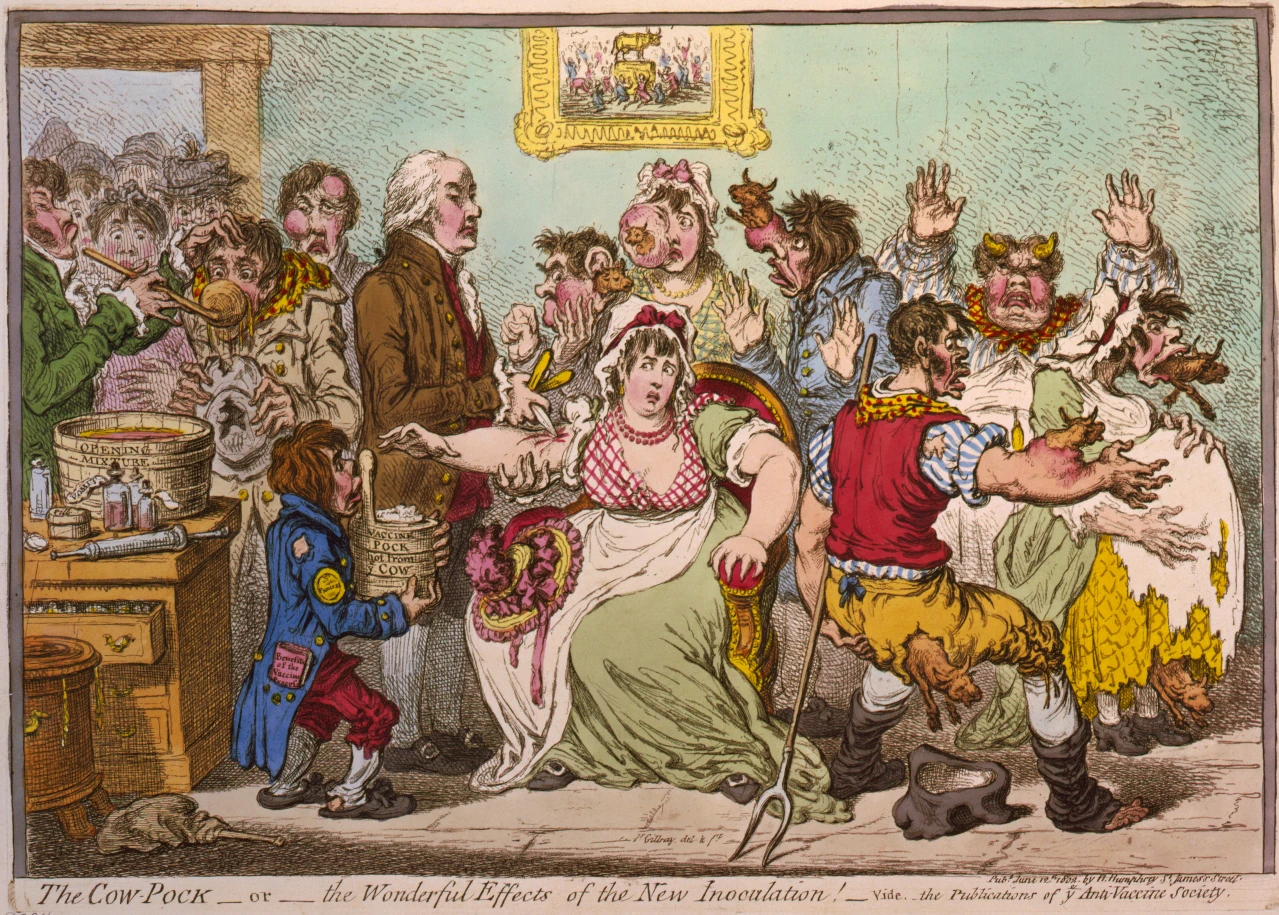
An 1802 cartoon of the early controversy surrounding Edward Jenner’s vaccination theory, showing using his cowpox-derived smallpox vaccine causing cattle to emerge from patients. Wikimedia Commons.
Smallpox struck Quebec for the last time in 1885. Almost a century had passed since the conception of the smallpox vaccine, yet vaccination was not widespread among French Canadians despite efforts by governments to encourage or even impose it.
In March 1885, a conductor of the Grand Trunk Railway brought smallpox to Montreal. His bedsheets then infected Pélagie Robichaud, a worker in the laundry room of the hospital where the man was receiving treatment. She was the first to victim of the 1885 smallpox epidemic. Her burial indicates that she passed away in Montreal on April 2nd.
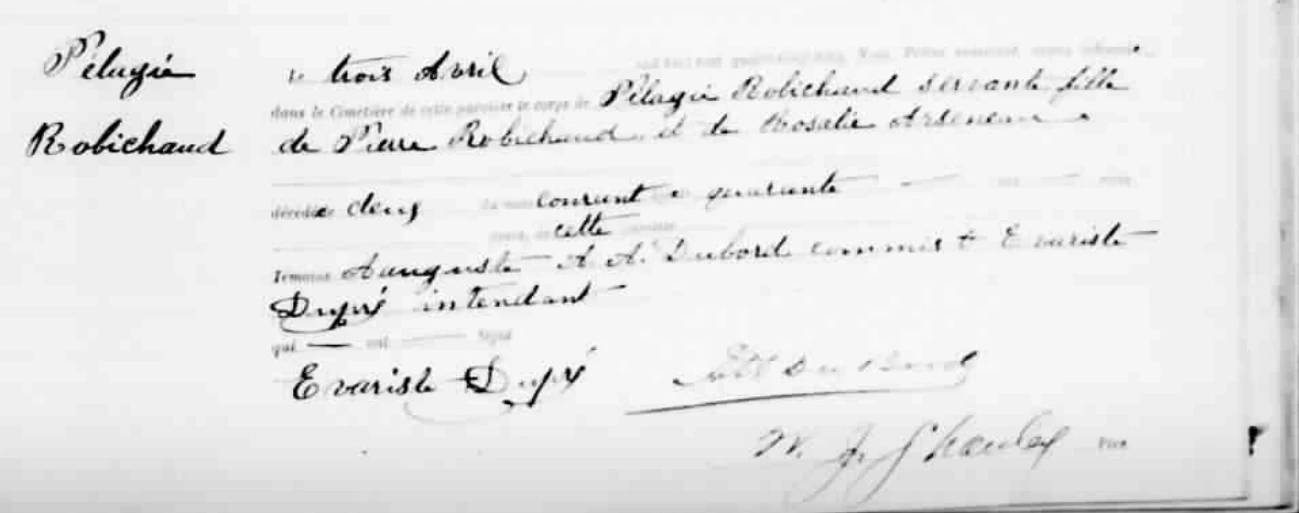
Source: Image d1p_1101a1007.JPG, Drouin Collection Records (Québec/Fonds Drouin/Mtl/Catholique/Montréal (Basilique Notre-Dame)/1880/1885/Sépultures/), GenealogyQuebec.com
Following the contagion of Pélagie Robichaud, the disease killed several thousand people in 1885 and 1886, with Montreal at the center of the epidemic. Vaccination was imposed on Montrealers, not without resistance: several anti-vaccination riots broke out among the suspicious population.
The anti-vaccine movement had influential figures on its side. Joseph Émery-Coderre, an eminent doctor campaigning against compulsory vaccination, is a notable example. The Catholic Church was called in to convince the reluctant population. Édouard-Charles Fabre, Bishop of Montreal at the time, played a decisive role in garnering public support for the vaccination campaign; he would order the priests of his diocese to do the same.
This crisis arose in a complex political context: it broke out at the same time as the North West rebellion, during which the Métis of the Prairies revolted against the Canadian government. The Métis of Western Canada, who are primarily descended from French Canadians and First Nations, were mostly French-speaking and Catholic, and their rebellion enjoyed considerable support in Quebec.
Its failure, which notably resulted in the hanging of Louis Riel, considerably exacerbated tensions between Francophones and Anglophones in Quebec as well as the distrust of French Canadians towards government directives. John A. Macdonald, then Prime Minister of Canada, is credited with the phrase “[Riel] shall hang though every dog in Quebec bark in his favour.”
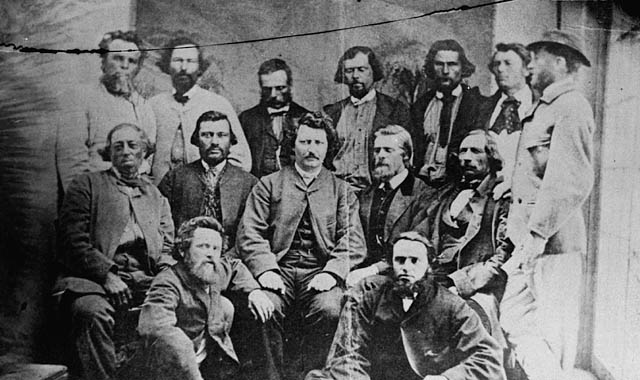
Louis Riel and the Métis provisional government. Wikimedia Commons.
French and English-language newspapers were passing the buck, on the one hand evoking the hysteria of English Canadians and on the other hand the uncleanliness of French Canadians. On September 12th, 1885, L’Union des Cantons-de-l’Est, based in Victoriaville, published an article on the alleged ravages of smallpox. Here is the introduction:
” If we were to believe the American newspapers published in English, we would think that smallpox is decimating the good city of Montreal. Practically speaking, our commercial metropolis is currently in quarantine at this time! Many people are suffering, and many more will suffer from this state of affairs. And whose fault is it? It is your city’s press, good people of Montreal. It spread everywhere that smallpox was eating away at you, that the plague was taking on horrible proportions, that the whole city was going to have to go through it. “
Thus, this article accuses English-language newspapers of greatly exaggerating the proportions of the smallpox epidemic, especially since English Canadians seemed to attribute the gravity of the situation to French Canadians:
” Now, as there needs to be a bête noire everywhere, it was imagined that French Canadians must be the originators and propagators of the epidemic. The Montreal Herald accused our conationals of being ignorant, dirty, filthy, etc. This is a big slander! Our French Canadian women are generally clean, industrious, spending three quarters of their time washing and cleaning in their homes. “
However, this article does not reject science and recognizes the shortcomings of the French-Canadian population when it comes to hygiene.
” The ravages of indifference to reading and science are infinitely more to be feared than those of smallpox in Montreal, whose victims do not exceed a few dozen. “
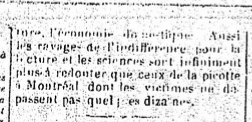
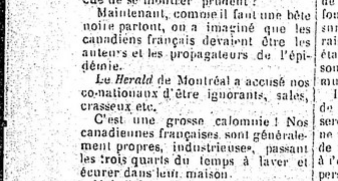
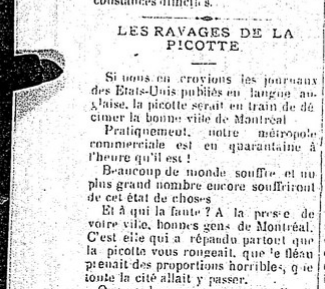
Source: Image 00080.jpg, Drouin Institute’s Miscellaneous Collections (23 – Journaux anciens/L’Union des Cantons de l’Est (Arthabaskaville)/1867-1887/1885/), GenealogyQuebec.com
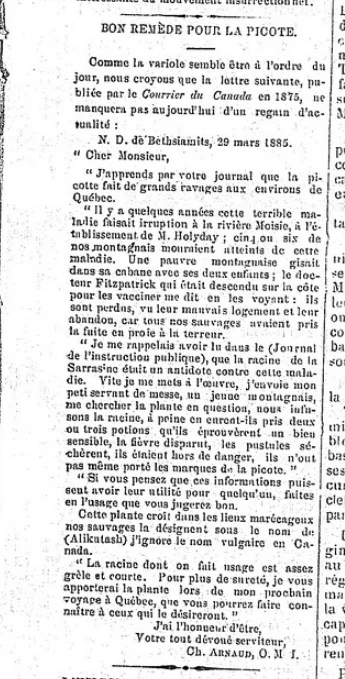
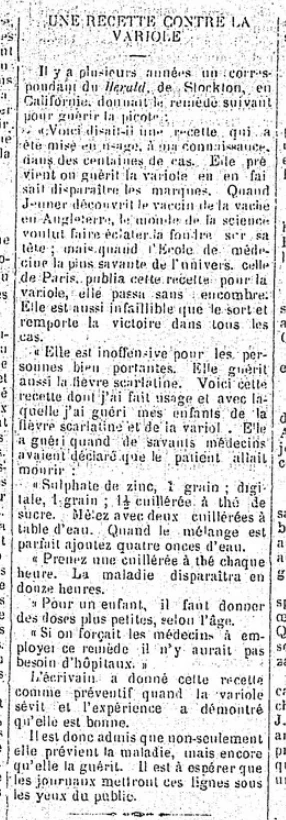
Also in September 1885, however, remedies and recipes for smallpox were published in L’Union des Cantons-de-l’Est, perpetuating the idea that vaccination was superfluous at best, if not dangerous.
” I remember reading in the (Journal de l’Instruction publique) that the Sarracenia root was an antidote against this disease. Quickly I set to work, I sent my altar boy, a young Montagnais, to fetch me the plant in question, we infused the root, scarcely had they taken two or three potions that they felt sensibly better, the fever disappeared, the pustules dried out, they were out of danger, they did not even bear the marks of smallpox. ”
” When Jenner discovered the cowpox vaccine in England, the world of science wanted to strike lightning upon his head; but when the most learned medical school in the universe, that of Paris, published this recipe for smallpox, it passed without a hitch. It is as infallible as fate and wins in all cases.
Zinc sulphate, 1 grain ; digitalis, 1 grain ; 1 1/2 teaspoon of sugar. Mix with two tablespoons of water. When the mixture is perfect add four ounces of water. Take a teaspoonful every hour. The disease will go away within twelve hours. “
Source: Images 00078.jpg and 00084.jpg,
Drouin Institute’s Miscellaneous Collections(23 – Journaux anciens/L’Union des Cantons de l’Est (Arthabaskaville)/1867-1887/1885/),
GenealogyQuebec.comThe 1885 epidemic was the last major health crisis related to smallpox in the Western world, just under a century before the complete eradication of the sickness thanks to vaccination. 1979 marked the end of the virus responsible for one of the deadliest contagious diseases in human history, of which only a few samples remain to this day for research purposes.
Marielle Côté-Gendreau
Student and Université de Montréal’s Programme de recherche en démographie historique (PRDH) collaborator.
Frequently asked questions
Pélagie Robichaud worked in the laundry room of the hospital treating a Grand Trunk Railway conductor who brought smallpox to Montreal in March 1885. Infected by his bedsheets, she died in Montreal on April 2nd, according to her burial record.
Vaccination was not widespread among French Canadians despite government efforts. The crisis also coincided with the North West rebellion and the hanging of Louis Riel, which increased French Canadians’ distrust of government directives.
The 1885 issues of L’Union des Cantons-de-l’Est quoted in this article come from the Drouin Institute’s Miscellaneous Collections, in the old newspapers section, available on GenealogyQuebec.com. They include a September 12th, 1885 article on the alleged ravages of smallpox.
Her burial record can be found in the Drouin Collection Records, among the 1885 burials of the Notre-Dame Basilica in Montreal, on GenealogyQuebec.com. It indicates that she passed away in Montreal on April 2nd, making her the first victim of the epidemic.