- A majority of historical claims of extreme longevity end up being proven false, as ages at burial were often inaccurate.
- Pierre Joubert, wrongly believed to have lived to 113 and featured in the Guinness Book of Records, is a well-known example.
- By linking birth and death dates from baptism and burial records, the PRDH determines an individual’s exact age at death.
- The first five French-Canadian centenarians were women, and the 100 year mark was first reached in 1825.
- No French-Canadian man reached 100 before 1850; François Parent, the oldest, died at 99 in 1834.
Lifespan is a topic that undoubtedly fascinates us. Cases of extreme longevity are regularly featured in the media, where individuals with extreme lifespans sometimes become symbols of national pride for their fellow citizens.
French-Canadiens are no exception. The case of Pierre Joubert, born in 1701 and erroneously believed to have lived to the ripe old age of 113 years old – as was featured in the Guinness Book of Records – was cited by Joseph-Charles Taché, a senior official in charge of Canada’s 1871 census, as an exemple of how French-Canadians formed “a population that, more than any other, perhaps, offers numerous examples of high longevity“.
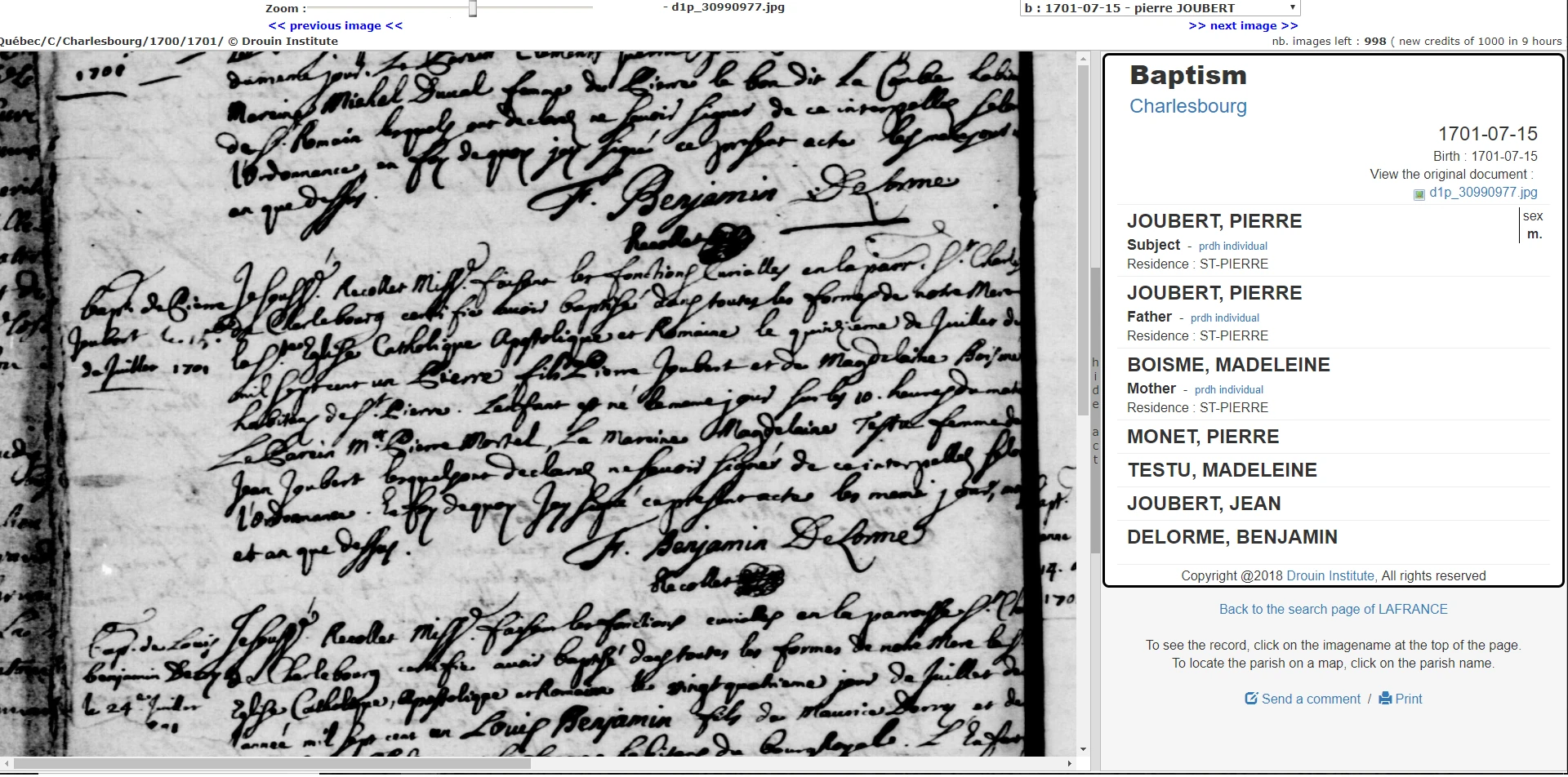
The problem is this topic, in an historical context, is prone to a lot of myths and exaggerations, so much so in fact that a majority of high longevity claims end up being proven false. The ages declared at the time of burial were particularly inaccurate, especially in the case of elderly individuals. Most people being illiterate, the documentation relative to a person’s birth wasn’t necessarily available or used, and the accuracy of the deceased’s age in the burial record was not considered important, being mostly an approximation.
Thankfully, the wonderful information compiled by the Programme de recherche en démographie historique (PRDH), publicly available on the PRDH-IGD.com website, allows us to mitigate the issue of inaccurate ages in burial records. By linking the birth and death dates available through baptism and burial records, it is possible to accurately determine an individual’s age at death.
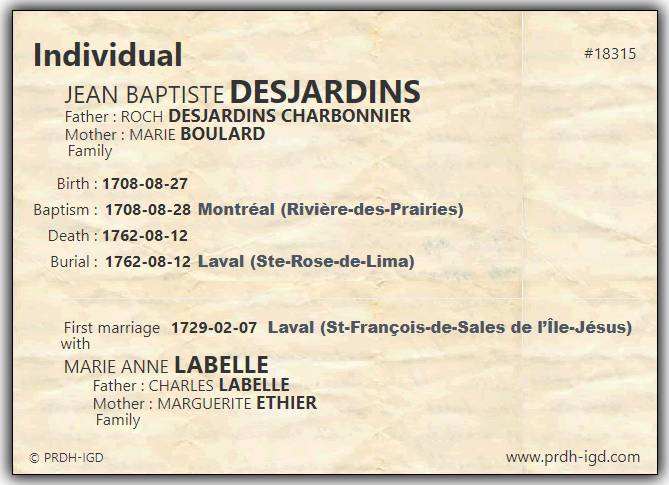
Thanks to this compiled data, it is possible to establish clear trends in the shifting of the mortality rate over time, as well as track the apparition of the first centenarians in the province.
This table identifies the 10 individuals born in Quebec that have reached the age of 99 years old before 1850:
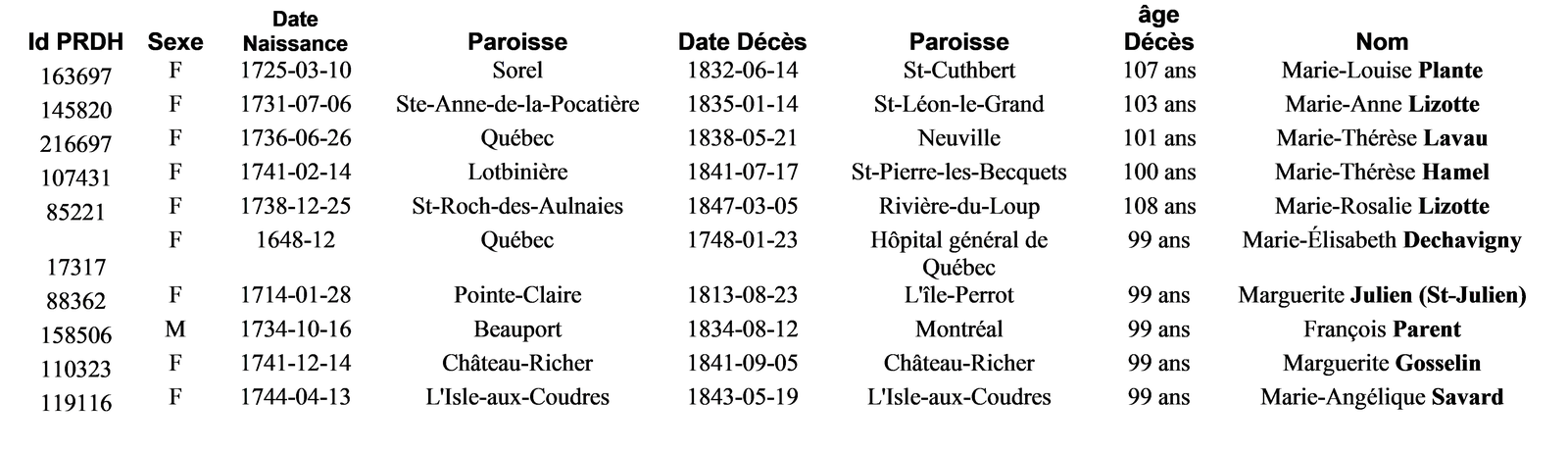
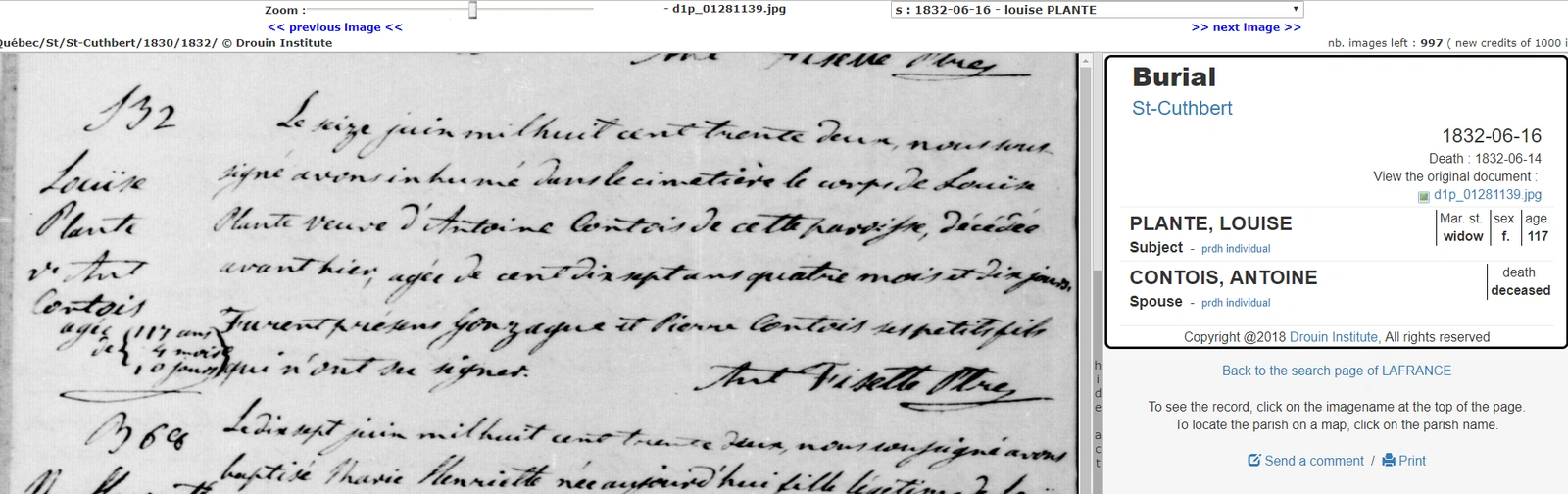
We can see that the first five French-Canadian centenarians were women. While Marie-Élisabeth Dechavigny, one of the very first inhabitants of the country, reached the age of 99 years old in 1748, it is only in 1825 that we see an individual reach the 100 year mark. Not only that, Marie-Louise Plante is believed to have lived to the very respectable age of 107 years old!
François Parent is the oldest French-Canadian male listed in the PRDH database(1621-1849), dying at the age of 99 years old in 1834; no French-Canadian man reached the age of 100 years old before 1850, and as such, the first male French-Canadian centenarian still remains to be identified!
Bertrand et François Desjardins
April 2018
Frequently asked questions
Ages declared at burial were particularly inaccurate for elderly individuals. Most people were illiterate, birth documentation was not necessarily available or used, and the age of the deceased was not considered important, being mostly an approximation.
The Programme de recherche en démographie historique (PRDH) links each individual’s birth and death dates, taken from baptism and burial records, which gives an accurate age at death. This data is publicly available on the PRDH-IGD.com website.
The first five French-Canadian centenarians were women. Marie-Élisabeth Dechavigny reached 99 in 1748, but it was only in 1825 that someone reached 100. Marie-Louise Plante is believed to have lived to the age of 107.
No. Pierre Joubert, born in 1701, was erroneously believed to have lived to 113, as featured in the Guinness Book of Records. Joseph-Charles Taché, in charge of Canada’s 1871 census, cited his case as an example of French-Canadian longevity.