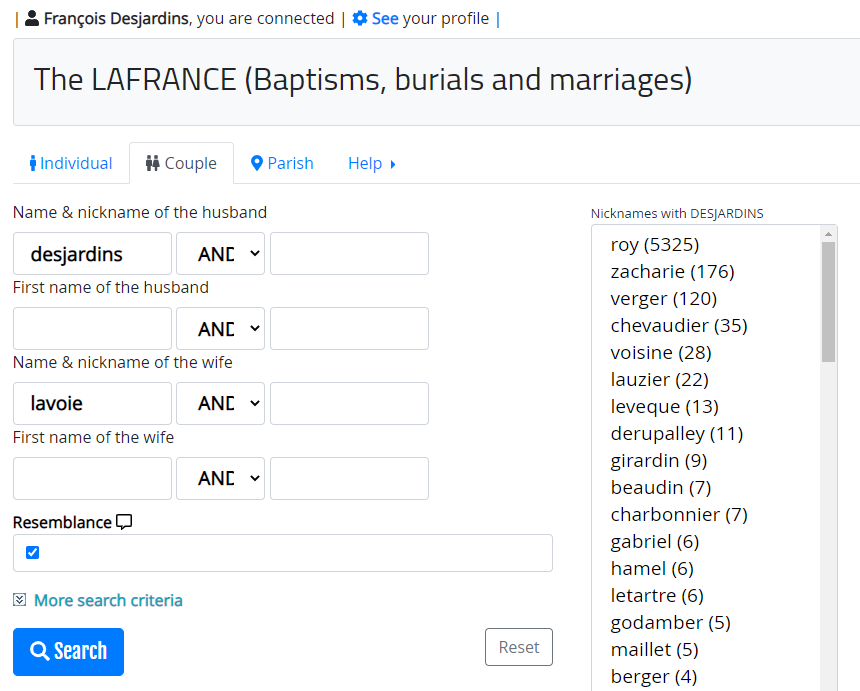
- The collection gathers marriage and death forms recorded in Quebec between 1926 and 1997, all denominations included.
- It can be browsed in the LAFRANCE tool with a subscription to Genealogy Quebec.
- For events before 1941, the matching church record can be found in the Drouin Collection Records.
- Marriage forms name the parish, which makes the church record rather easy to trace.
- Death forms only give the place of residence, so finding the burial record may take some detective work.
⚠️ Note: This guide pertains to one of Genealogy Quebec’s legacy tools, which are no longer updated. Their content is now integrated into the new unified search engine.
Marriages and Deaths 1926-1997 is a collection of marriage and death forms recorded in Quebec between 1926 and 1997, all religious denominations included.
This collection can be browsed in the LAFRANCE tool at this address.
You can browse the Marriages and Deaths 1926-1997 collection as well as tens of millions of historical and genealogical documents by subscribing to Genealogy Quebec today!

Finding the original church record using the information provided in a Marriages and Deaths 1926-1997 document
Since the Marriages and Deaths 1926-1997 forms are based on vital events, there will often exist a parish record associated with the event. It can be interesting to seek out the church record associated with an event, particularly in the case of deaths, as the original form isn’t available in the 1926-1997 collection.
As a Genealogy Quebec subscriber, you have access to the entirety of Quebec’s Parish Registry up until 1940 through the Drouin Collection Records. As such, you should be able to find the original church records associated to the forms that predate 1941.
Marriages
In the case of the marriages, the parish in which the marriage was recorded is mentioned in the form, which allows us to trace the parish record rather easily.
As an example, we will use the marriage form of Florent Beaudoin and Madeleine Lafond, which we have found in the Marriages 1926-1997 collection on the LAFRANCE.

The first step is to make sure the marriage falls within the date range covered by the Drouin Collection Records. Since this marriage was celebrated on the 23rd of February 1935, and so before 1941, we should be able to find the church record associated to it. The form indicates that the parish is “Montréal – N-D-du-Rosaire”.
We will find the original church record by browsing the parish register of Notre-Dame-du-Rosaire for the year 1935 in the Drouin Collection Records.
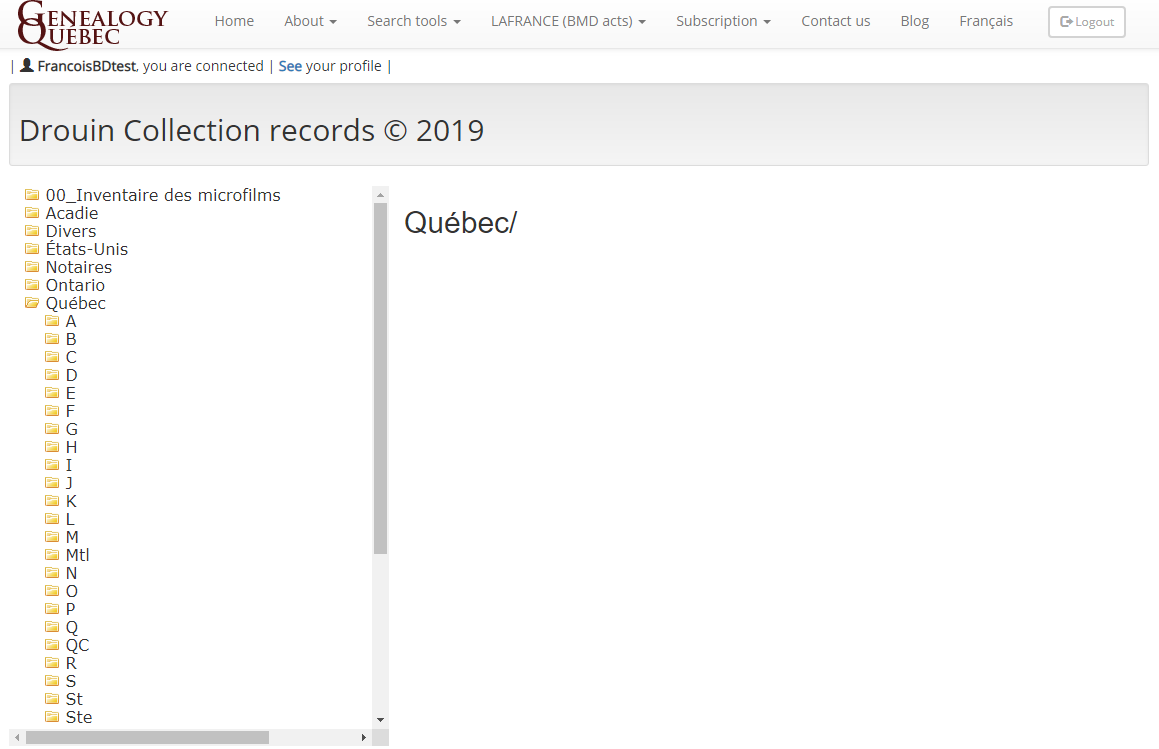
Once in the Drouin Collection Records, you will notice that the various registers are organized in a file tree structure. We will begin by opening the Quebec folder, as the parish we are looking for is in Quebec. Inside the Quebec folder, we must find the right parish folder.
Some parishes will be listed under the name of the city or region they are located in, while others will be listed under the name of the parish itself.
In the case of Montreal-based parishes, they are first sorted under the “Mtl” folder, and then under their religious affiliation. Notre-Dame-du-St-Rosaire is listed as “Montréal (Notre-Dame-du-St-Rosaire)” under the “Catholique” folder.
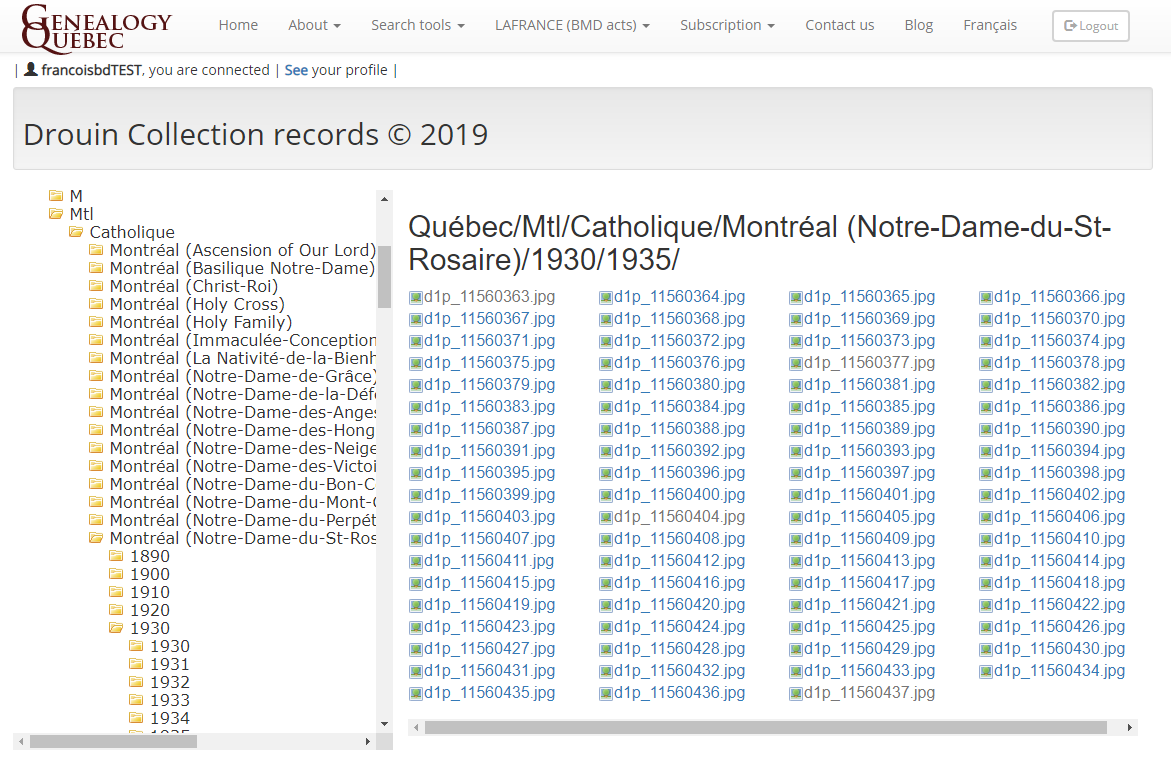
Once inside the correct folder, we must navigate to the right year, which will give us access to all the images associated with that register for that specific year. It is important to know that in general, the images are listed in chronological order.
This means that the first image in the folder will contain the first events recorded in the year, which are usually the ones from January. Similarly, the last few images in the folder will be those from the end of the year.
However, in the case of Notre-Dame-du-St-Rosaire, the baptisms and marriages were recorded in two different books. As such, the 1935 marriages begin in the middle of the image series. A bit of navigation will be necessary to find the record we are looking for.
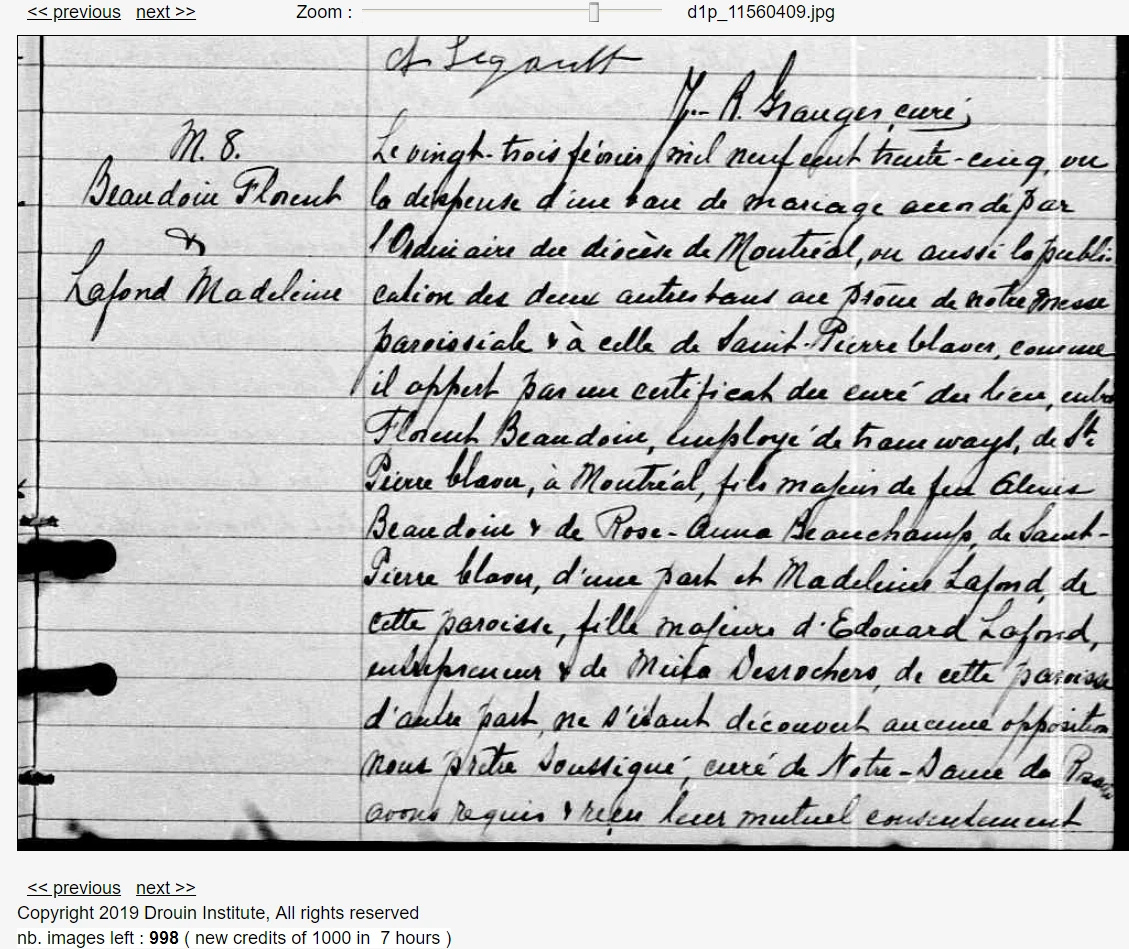
And with that, we were able to find the church record associated to the marriage form found in the Marriages 1926-1997 collection.
Deaths
Finding the original church record associated with a death form is a little more complicated, as the form does not provide us with the parish information. Nonetheless, the form does give us the place of residence of the deceased. With that information, we can often find the correct parish. This may prove harder for larger cities, as they often have multiple parishes. Some detective work may be needed!
As an exemple, we will try to find the burial record associated to Louise Roy’s death form.

The form tells us that Louise Roy died on the 11th of November 1928, and that she lived in St-Hyacinthe. Although St-Hyacinthe is not identified as being the city where the death was recorded, it is likely that it is where we will find the burial since the deceased lived there.
Browsing the St-Hyacinthe folder in the Drouin Collection Records, we notice that it contains several sub-folders associated with different parishes. Since we have no way of knowing which parish would contain the burial record, we will have to browse one folder at a time. The first folder contains the Cathédrale de St-Hyacinthe parish register.
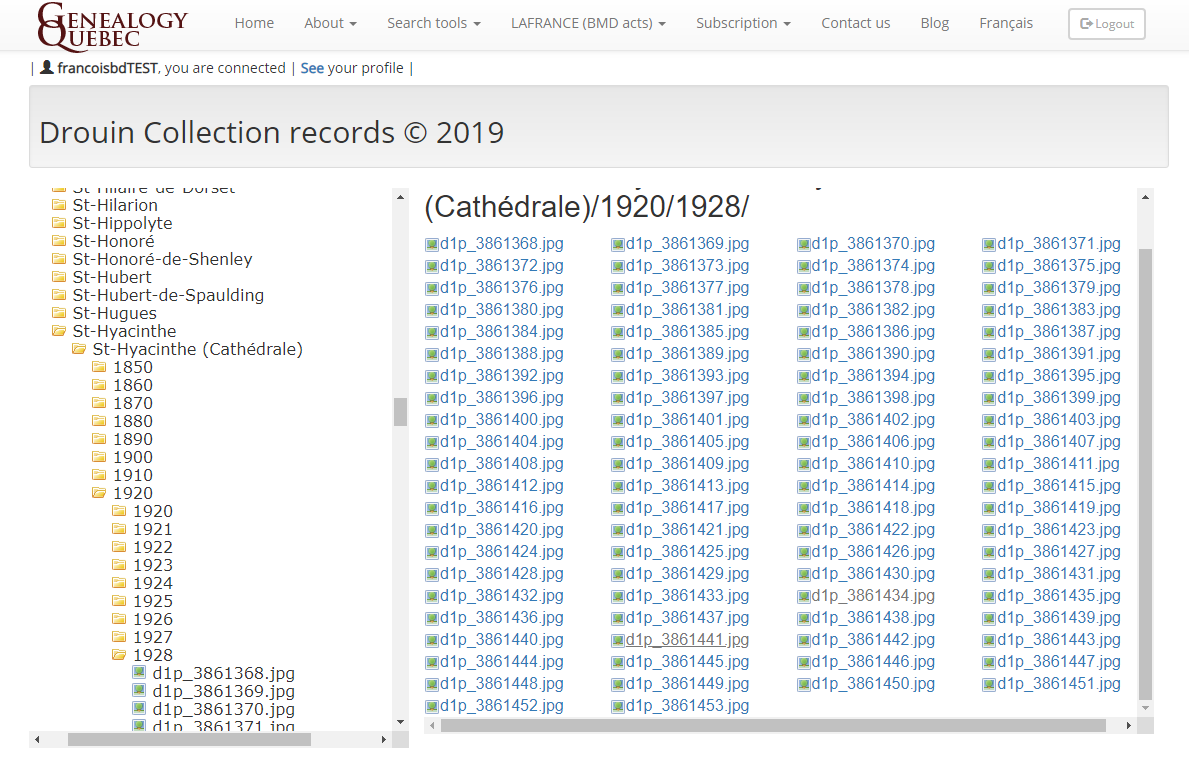
Since the death occurred in November, we begin our consultation among the last few images in the folder. It is very possible that the burial was not recorded the same day as the death, as it was common for a burial to be recorded one or two days after the death of the person. While browsing the register, we must keep in mind that the date of the burial could be the 12th or even the 13th of November, 1928.
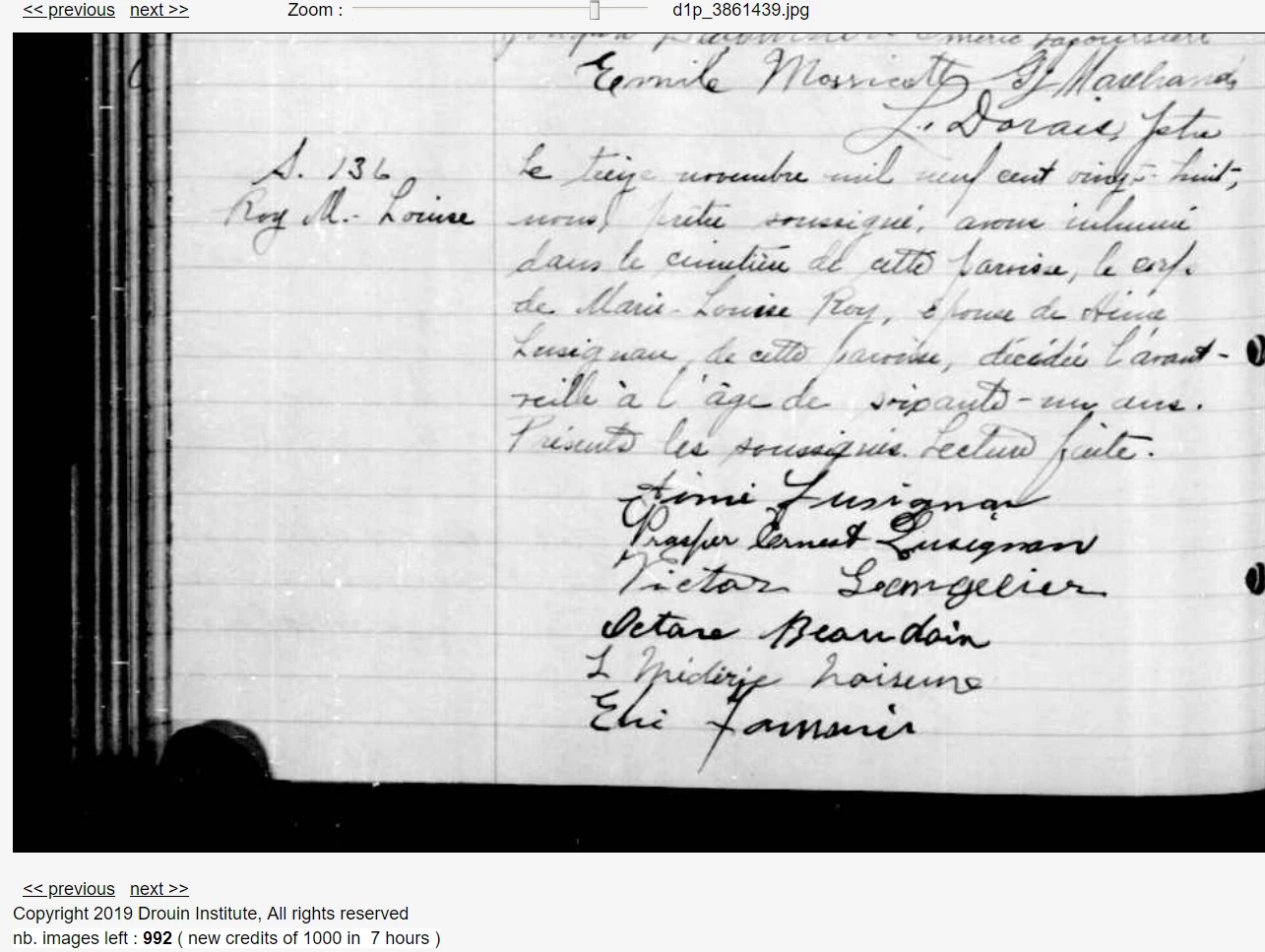
And indeed, the burial was recorded on the 13th of November. With a little detective work, we were able to find the original church record associated to a Deaths 1926-1997 form, which provides us with some additional information regarding the event.
Useful links
Search the Marriages and Deaths 1926-1997 collection on the LAFRANCE
Frequently asked questions
Most of these vital events were also recorded by the church, and the parish record can add information. It is especially useful for deaths, since the original death form is not available in the collection. Records before 1941 are in the Drouin Collection Records.
The marriage form names the parish. Browse that parish’s register for the year of the marriage in the Drouin Collection Records. Montreal parishes are sorted under the “Mtl” folder, then by religious affiliation, such as the “Catholique” folder.
Start from the place of residence given on the death form and browse the registers of the parishes in that place. In a city with several parishes, such as St-Hyacinthe, you will have to browse one parish folder at a time.
It was common for a burial to be recorded one or two days after the death. Louise Roy died on November 11, 1928, and her burial was recorded on November 13. When browsing a register, check the days following the date of death as well.