- The Université de Montréal’s PRDH launched its website in the summer of 1999 to share its genealogical data with the public.
- The PRDH database is a computerized population register of all individuals of European ancestry who lived in the St. Lawrence Valley.
- Each biography is built by attributing baptism, marriage and burial records to the right person through family reconstruction.
- A collaboration with the Drouin Genealogical Institute extended the database to 1849, tripling the number of civil records.
- Today, PRDH-IGD.com contains more than 2.5 million records for researchers and for amateur and professional genealogists.
The PRDH website is celebrating its 20th anniversary! It was in the summer of 1999 that the Université de Montréal’s Programme de recherche en démographie historique (PRDH) launched the website, with the goal of sharing the genealogical information compiled by the PRDH with the public.
Produced in collaboration with Maison Gaëtan Morin éditeur, and thanks to a grant from the Fonds de l’autoroute de l’information, an initiative of the Government of Quebec aimed at increasing the presence of French-language content on the Internet, the website was the latest step in an already 20 year old process of making the PRDH data available outside of the academic fields.
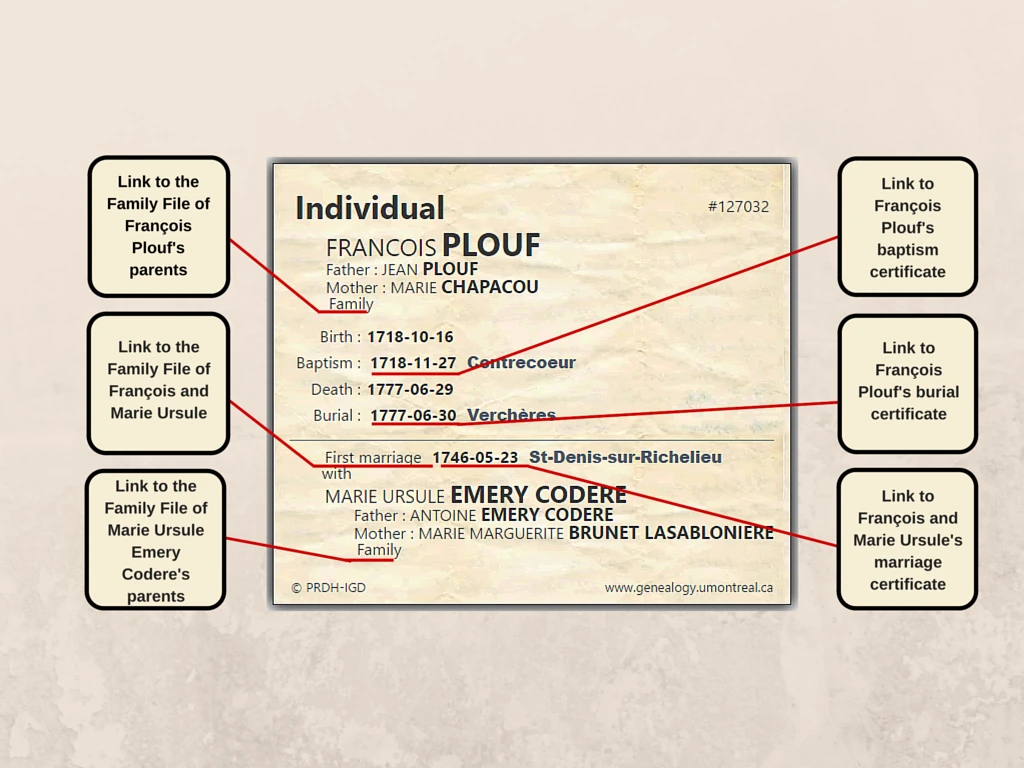
The PRDH database takes the form of a computerized population register, composed of biographical files on all individuals of European ancestry who lived in the St. Lawrence Valley. The file for each individual gives the date and place of birth, marriage(s), and death, as well as family and conjugal ties with other individuals. This basic information is complemented by various socio-demographic characteristics drawn from documents: socio-professional status and occupation, ability to sign his or her name, place of residence, and, for immigrants, place of origin.
Over the years, the PRDH has become an evolutionary and multi-purpose database, available for queries regarding various human populations in general and that of Quebec in particular. It is a truly interdisciplinary information system.
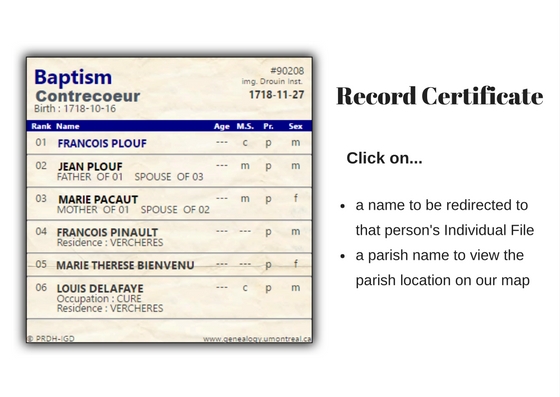
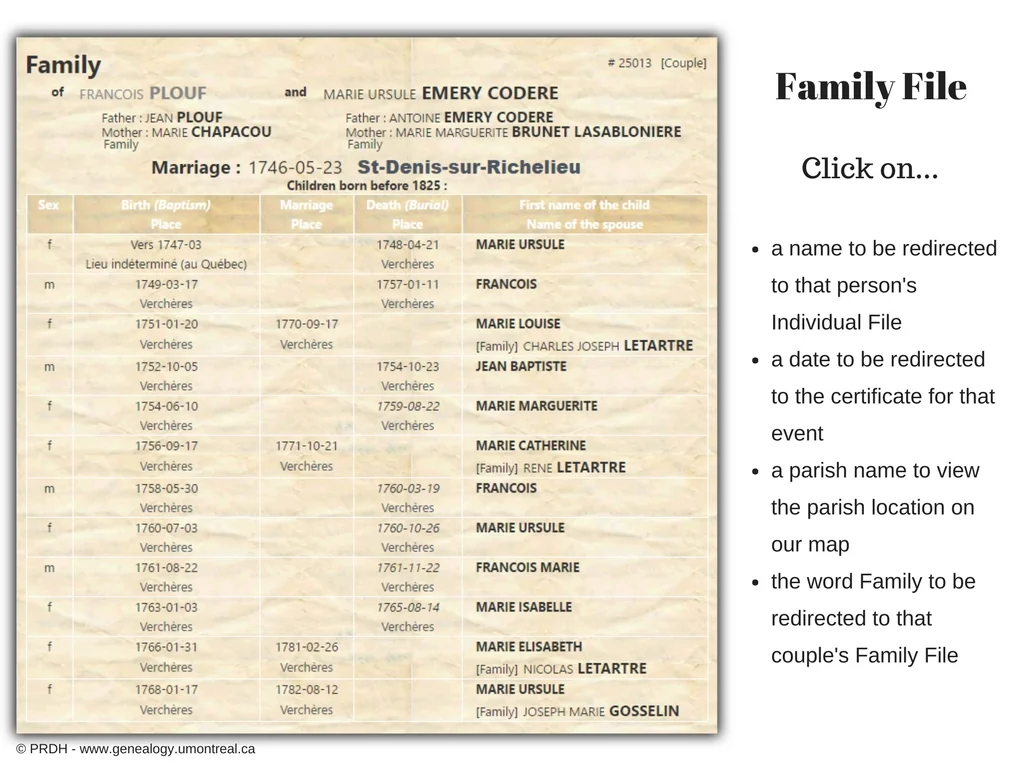
The project relies on exhaustive gathering of data from the parish registers of old Quebec. By systematic attribution of baptism, marriage, and burial certificates to the respective individuals – a “family reconstruction” made on the basis of names and family ties – people are identified and their biographies established. Thus, the PRDH contains the personal history of the Quebec ancestors of all French-Canadians and is of interest to a broad public.
That is why the PRDH inaugurated, in 1980, a series of publications intended for the general public – directory of baptisms, marriages and burials in 47 volumes covering the French Regime, CD-ROM extending this directory to the whole of the XVIIIth century, Genealogical dictionary of families from the origin of the province to 1765 on Cd-Rom -, culminating with the opening of the website in 1999. The sale of these various products derived from its academic activities has provided the PRDH with revenues that have always been reinvested in the project.
Constantly corrected when necessary and enriched over time, the PRDH site quickly became the reference for 17th and 18th century genealogy in Quebec. Moreover, the PRDH established a fruitful collaboration with the Drouin Genealogical Institute about ten years ago to pool their resources and expertise to extend the coverage of the PRDH database to the 1840s. Assisted by a grant from the Canadian Foundation for Innovation (CFI) obtained for the establishment of an integrated infrastructure of historical micro-data of the population of Quebec (IMPQ), the PRDH directory has now been extended to 1849, tripling the number of civil records in the database.
Today, PRDH-IGD.com contains more than 2.5 million records and offers researchers, as well as amateur and professional genealogists, one of the most comprehensive database of its kind.
You can start using this incredible database right now by subscribing here!
And for a more in depth explanation of the database’s structure, as well as tips on how to best use the website, you’ll want to read this article on the Drouin Institute blog.
Bertrand and François Desjadins
Frequently asked questions
The PRDH (Programme de recherche en démographie historique) of the Université de Montréal builds a computerized population register. It contains biographical files on all individuals of European ancestry who lived in the St. Lawrence Valley, drawn from the parish registers of old Quebec.
Each file gives the date and place of birth, marriage(s) and death, along with family and conjugal ties. It is complemented by details drawn from the records, such as occupation, ability to sign one’s name, place of residence and, for immigrants, place of origin.
The PRDH gathers data exhaustively from the parish registers of old Quebec. It systematically attributes each baptism, marriage and burial record to the person concerned, a family reconstruction based on names and family ties, which establishes each individual’s biography.
The PRDH site first became the reference for 17th and 18th century genealogy in Quebec. Through a collaboration with the Drouin Genealogical Institute and a grant from the Canadian Foundation for Innovation, the database was extended to 1849, tripling its number of civil records.